

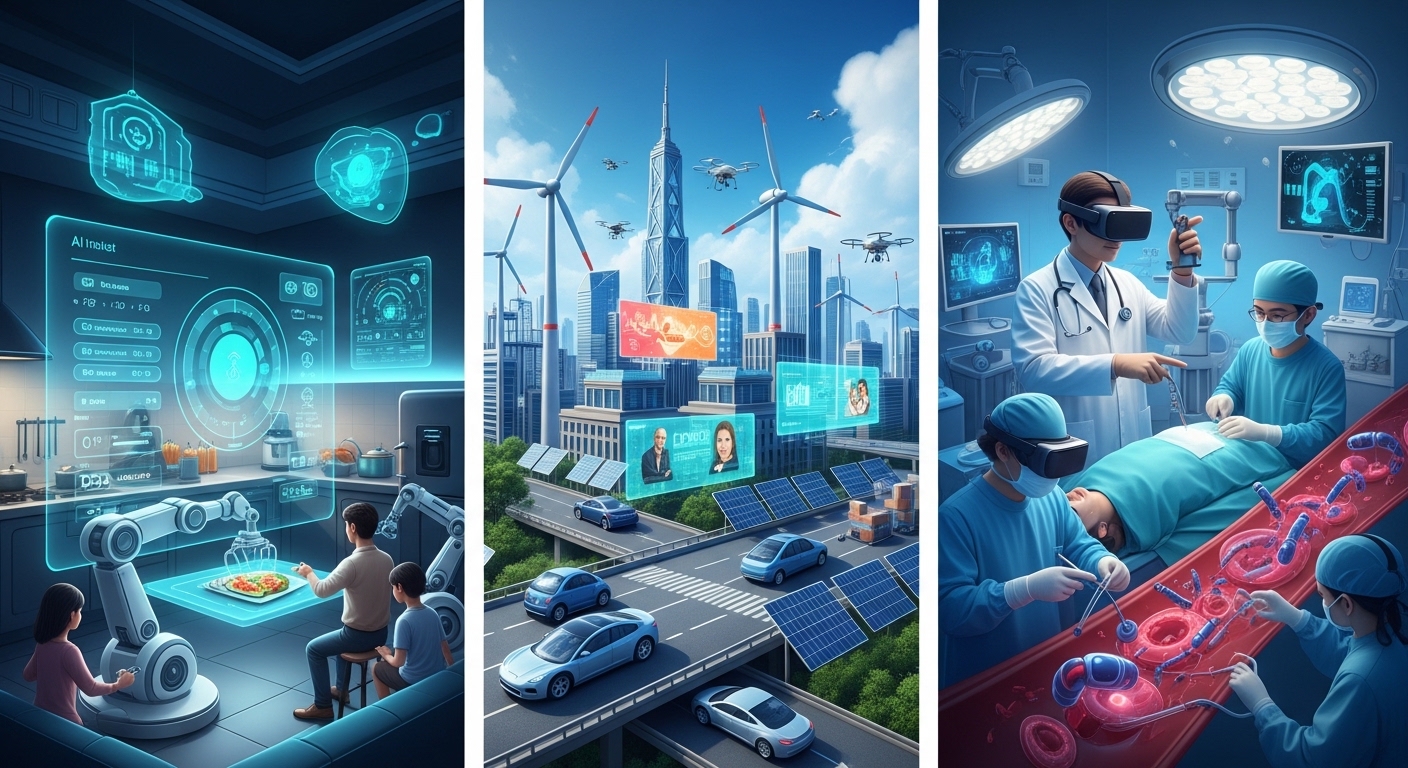
Technology is evolving faster than ever before, and the next decade is expected to bring groundbreaking innovations that will completely reshape how humans live, work, and communicate. From artificial intelligence to advanced biotechnology, future technologies will redefine industries, economies, and daily life in ways we are only beginning to imagine.
Artificial Intelligence and Automation Evolution
AI in Workplace Transformation
Artificial intelligence is transforming workplaces by automating repetitive tasks, improving decision-making, and enhancing productivity across industries. In the next ten years, AI systems will become more adaptive, allowing businesses to reduce costs, increase efficiency, and create smarter workflows that support human workers in complex environments.
AI Personal Assistants Future
Future AI personal assistants will evolve into highly intelligent systems capable of understanding context, emotions, and complex user needs. They will manage schedules, automate daily tasks, and provide personalized recommendations, making digital interaction more natural, efficient, and deeply integrated into everyday human life everywhere globally.
Autonomous Vehicles Impact
Autonomous vehicles will revolutionize transportation by reducing accidents, improving traffic flow, and enhancing mobility for people worldwide. Over the next decade, self-driving technology will become more reliable, widely adopted, and integrated into smart city infrastructure, transforming how humans travel and commute daily across global networks.
AI Ethics and Governance
AI ethics and governance will become critical as artificial intelligence systems grow more powerful and widespread. Governments and organizations will establish regulations to ensure transparency, fairness, and accountability, preventing misuse while encouraging innovation and protecting human rights in increasingly automated societies around the world today.
AI in Education Systems
AI in education systems will personalize learning experiences, adapt to student performance, and provide real time feedback to improve understanding. Intelligent tutoring systems will support teachers, enhance engagement, and make education more accessible and effective for learners across diverse backgrounds in coming years ahead.
Quantum Computing Breakthroughs
Quantum Computing Power Growth
Quantum computing will unlock unprecedented processing power by solving complex problems far beyond the capabilities of classical computers. In the next decade, breakthroughs in qubit stability and error correction will enable practical applications in cryptography, medicine, and scientific research across multiple industries worldwide transformation era.
Quantum Cryptography Security
Quantum cryptography will revolutionize digital security by creating virtually unbreakable encryption methods based on quantum principles. This technology will protect sensitive data, secure communications, and prevent cyberattacks, making online systems significantly safer for governments, businesses, and individuals across global security systems.
Quantum AI Integration
Quantum AI integration will combine quantum computing and artificial intelligence to solve highly complex problems at unprecedented speeds. This fusion will enhance machine learning, optimize systems, and enable breakthroughs in science, finance, and engineering that are currently impossible with classical computing future global systems.
Quantum Internet Future
Quantum internet will enable ultra secure communication networks using quantum entanglement and photon based data transfer. This revolutionary system will prevent data interception, improve global connectivity, and support next generation communication infrastructure across governments, businesses, and research institutions worldwide in the coming technological revolution era.
Quantum Computing Challenges
Despite rapid progress, quantum computing faces challenges such as high error rates, hardware instability, and limited scalability. Researchers are working to overcome these barriers through advanced materials, improved algorithms, and innovative cooling systems to make quantum technology practical and widely usable in real world applications.
Next Generation Connectivity
6G Network Speed Revolution
6G networks will deliver ultra fast connectivity with near zero latency, enabling seamless communication between billions of devices worldwide. This advancement will support immersive technologies, real time applications, and massive data transfer, transforming how humans interact with digital environments and connected systems globally at scale.
Smart Cities Connectivity
Smart cities will rely on advanced connectivity networks to manage traffic, energy, healthcare, and public services efficiently. These systems will integrate IoT devices, sensors, and AI analytics to improve urban living, reduce congestion, and enhance sustainability in rapidly growing metropolitan environments future urban life.
Satellite Internet Expansion
Satellite internet expansion will provide high speed connectivity to remote and underserved regions across the globe. This technology will bridge digital divides, improve access to education, and support global communication networks, ensuring reliable internet coverage even in geographically challenging areas next generation access systems.
Edge Computing Growth
Edge computing will process data closer to its source, reducing latency and improving efficiency in real time applications. This technology will support IoT devices, autonomous systems, and smart infrastructure, enabling faster decision making and reducing reliance on centralized cloud computing systems across global networks systems.
Network Security Future
Future network security will focus on advanced encryption, AI driven threat detection, and real time monitoring to protect global digital infrastructure. As connectivity increases, cybersecurity systems will become more intelligent, adaptive, and capable of preventing sophisticated cyberattacks across interconnected networks future secure systems era.
Biotechnology and Health Tech
Gene Editing Advances
Gene editing technology will revolutionize medicine by enabling precise modifications to DNA, helping treat genetic disorders and prevent inherited diseases. Advances in CRISPR and related tools will allow scientists to develop personalized therapies and improve human health outcomes significantly over the next decade worldwide impact.
AI Healthcare Diagnostics
AI powered healthcare diagnostics will enhance early disease detection, improve accuracy, and reduce medical errors in hospitals and clinics. Machine learning systems will analyze patient data, medical images, and genetic information to provide faster, more reliable diagnosis and treatment recommendations across modern healthcare systems.
Wearable Medical Devices
Wearable medical devices will continuously monitor vital signs such as heart rate, oxygen levels, and blood pressure, enabling real time health tracking. These devices will help detect early warning signs, support chronic disease management, and improve overall patient care and prevention strategies future health systems.
Personalized Medicine Future
Personalized medicine will tailor treatments to individual genetic profiles, improving effectiveness and reducing side effects. Doctors will use advanced data analytics and biotechnology to design customized therapies that match each patient’s unique biological makeup, transforming healthcare into a more precise and targeted system global shift.
Biotechnology Ethical Challenges
Biotechnology advancements raise ethical challenges regarding genetic modification, privacy concerns, and unequal access to advanced treatments. Governments and organizations will need to establish clear regulations to ensure responsible use of biotechnology while balancing innovation with safety, fairness, and human rights protection future policy framework.
Space Exploration and Commercialization
Commercial Space Travel Growth
Commercial space travel will expand rapidly as private companies develop reusable rockets and reduce mission costs. In the next decade, space tourism may become more accessible, allowing civilians to experience orbital flights and lunar visits, transforming space into a new commercial industry global space economy.
Mars Exploration Missions
Mars exploration missions will advance significantly with human landing plans, robotic rovers, and advanced research on planetary conditions. Scientists aim to study Mars atmosphere, search for signs of past life, and prepare for potential future colonization efforts in deep space exploration programs interplanetary research future.
Satellite Mega Constellations
Satellite mega constellations will provide global internet coverage through thousands of low Earth orbit satellites. These networks will improve communication speed, support remote connectivity, and enable real time data transmission for businesses, governments, and individuals across the planet in the coming decade global space network.
Space Mining Industry
Space mining will become a major industry as companies explore asteroids and lunar surfaces for valuable minerals and resources. This emerging sector could support Earth’s economy, reduce resource scarcity, and enable long term space infrastructure development across future missions driving future interplanetary economic systems growth.
Space Habitation Future
Future space habitation will focus on building sustainable colonies on the Moon and Mars using advanced life support systems, renewable energy, and autonomous construction technologies. These developments will support long term human survival beyond Earth and expand civilization into space environments future interstellar expansion era.
Smart Cities and IoT Expansion
IoT Urban Systems
Internet of Things technology will power smart cities by connecting devices, sensors, and infrastructure systems. This integration will improve traffic management, energy efficiency, and public services, creating more responsive and intelligent urban environments that enhance quality of life for citizens worldwide future connected living systems.
Smart Transportation Systems
Smart transportation systems will use AI, sensors, and real time data to optimize traffic flow, reduce congestion, and improve public transit efficiency. These technologies will enable safer, faster, and more sustainable urban mobility solutions across rapidly growing cities worldwide future intelligent transport networks era systems.
Urban Energy Management
Urban energy management systems will optimize electricity distribution using smart grids, renewable sources, and real time monitoring. These systems will reduce waste, lower costs, and improve sustainability in cities by balancing demand and supply efficiently across modern urban infrastructure networks global smart energy future systems.
Smart Waste Management
Smart waste management systems will use sensors and AI to optimize garbage collection, recycling processes, and waste reduction strategies. These technologies will improve urban cleanliness, reduce environmental impact, and support sustainable city development through efficient resource management practices across future smart urban ecosystems worldwide systems.
Public Safety Technology
Public safety technology will integrate AI surveillance, predictive analytics, and emergency response systems to improve security in urban environments. These systems will detect threats faster, coordinate responses efficiently, and enhance overall safety for citizens in increasingly connected smart cities worldwide future safety innovation era systems.
Future of Human Machine Interaction
Brain Computer Interfaces
Brain computer interfaces will enable direct communication between the human brain and machines, allowing control of devices through thought. This technology will transform healthcare, gaming, and communication, offering new possibilities for accessibility, cognitive enhancement, and immersive digital interaction experiences future human machine integration systems era.
Augmented Reality Expansion
Augmented reality will blend digital content with the physical world, enhancing experiences in education, gaming, navigation, and retail. This technology will allow users to interact with virtual objects in real environments, creating more immersive and engaging digital experiences across industries future immersive tech world systems.
Holographic Displays
Holographic displays will project three dimensional images into real space, allowing users to interact with digital content without screens. This technology will revolutionize communication, entertainment, and education by creating realistic, interactive visual experiences that feel physically present future holographic communication technology evolution era systems now.
Emotion AI Systems
Emotion AI systems will analyze human feelings through facial expressions, voice tone, and behavioral patterns, enabling machines to respond more naturally and empathetically. This technology will improve customer service, healthcare, and human computer interaction across various digital platforms and industries future emotional intelligence systems era.
Human Machine Collaboration
Human machine collaboration will define the future workplace, where humans and intelligent systems work together to enhance productivity and creativity. This partnership will combine human intuition with machine precision, transforming industries and enabling new levels of innovation and efficiency future work evolution era systems.
FAQs
What is the biggest future technology trend?
Artificial intelligence and automation are expected to dominate future technological development.
How will AI change daily life?
AI will automate tasks, improve decision making, and personalize digital experiences.
Will robots replace humans in jobs?
Robots will replace repetitive tasks but also create new job opportunities.
What is 6G technology?
6G is the next generation of wireless connectivity with ultra fast speed and low latency.
How will healthcare improve in the future?
Healthcare will become more personalized, AI driven, and real time monitored.
Conclusion
The future of technology promises massive transformation across industries including AI, quantum computing, space exploration, biotechnology, and smart cities. Over the next ten years, innovation will reshape human life, improve efficiency, and create new opportunities. As advancements accelerate, societies must adapt responsibly to ensure technology benefits humanity, drives growth, and supports sustainable global progress for generations ahead.
