

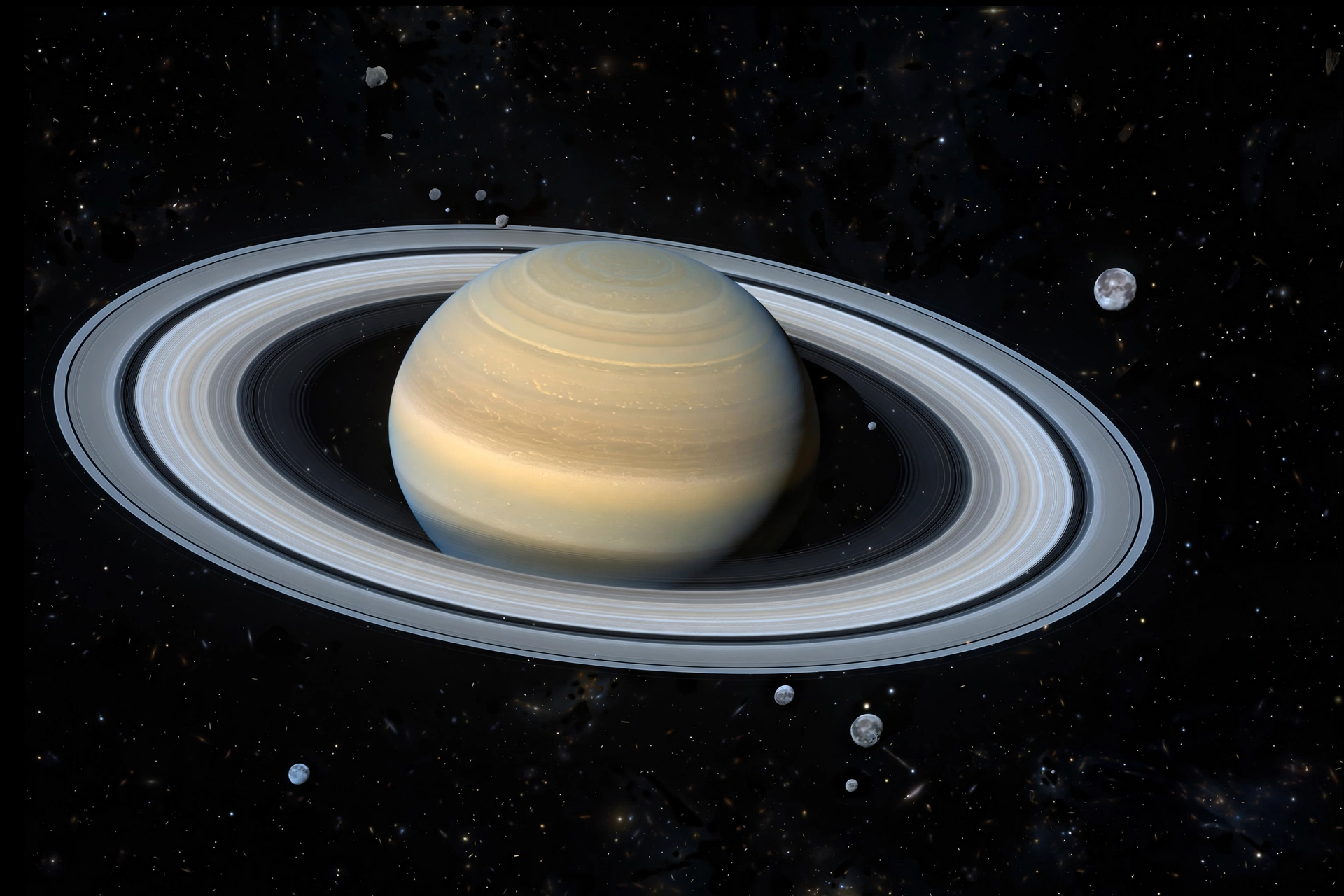
Saturn has pulled so far ahead in the moon race that the race is effectively over. Astronomers have confirmed 128 additional moons, raising Saturn’s official total from 146 to 274 — more than the moons of all the other planets put together. For a lab-minded readership, though, the headline number is the least interesting part. The real story is methodological: how do you detect objects a few kilometres wide, hundreds of millions of kilometres away, that reflect almost no sunlight at all? The answer is a clever imaging trick, years of archived data, and a survey telescope in Hawaii built for exactly this kind of deep, wide stare.
The Shift and Stack Technique, Explained
The survey used the Canada-France-Hawaii Telescope on Mauna Kea, and a method astronomers call shift and stack. A single exposure cannot reveal these moons; each is far too faint. But if you take many deep images and shift each one to compensate for Saturn’s motion across the sky, then stack them, the moons reinforce one another and emerge from the noise, while distant background stars smear into trails. It is signal processing as much as observing. The Canada-France-Hawaii Telescope team gathered the underlying images over several years, which is why confirmations can arrive in a flood long after the photons were collected.
Who Did the Work
The research group included scientists from the University of British Columbia, among them Dr Edward Ashton, and the resulting catalogue has been recognised by the International Astronomical Union. That recognition matters more than it might sound. Plenty of faint candidates orbit Saturn on paper; only objects with orbits tracked well enough to be predicted years into the future earn a place in the official count. The jump from 146 to 274 therefore represents not just new detections, but new detections that survived a demanding verification process — the astronomical equivalent of passing peer review with your workings shown.
A Population of Irregulars
The confirmed moons are irregular satellites: small bodies on distant, tilted orbits, many of them retrograde, travelling opposite to Saturn’s spin. Regular moons, formed from the same disc of material as the planet, keep tidy equatorial paths. Irregulars look like interlopers, and that is almost certainly what they are — objects captured by Saturn’s gravity long after the planet formed. Their orbits are elongated and inclined at odd angles, and they cluster into families with similar paths. For dynamicists, those clusters are data: they encode the capture events and collisions that assembled Saturn’s outer system.
Collisional Families and Shattered Parents
The clustering points to a violent history. Many of the 128 new moons are best explained as fragments of larger captured moons that were shattered by collisions, their debris gradually spreading along related orbits. That hypothesis makes testable predictions about how fragment sizes and orbits should be distributed, which is precisely why a bigger census is scientifically valuable. With only a few dozen known members, a family could be a coincidence. With 274 moons in the catalogue, patterns become statistics. If you enjoyed our earlier explainer on a SpaceX launch lighting up the East Coast, this is the quieter, slower counterpart — discovery by archive rather than by rocket.
What a Complete Census Makes Possible
Planetary scientists use moon populations to test formation models. Capture rates, collision frequencies and long-term orbital stability all leave fingerprints in the size and orbit distribution of irregular moons. A census that is closer to complete — at least down to a few kilometres — lets researchers compare Saturn’s system against Jupiter’s, Uranus’s and Neptune’s with far less sampling bias. It also sets a benchmark for future surveys: if shift and stack mining of archival images found this many, dedicated deep surveys with the next generation of telescopes should find smaller and fainter members still hiding in the glare and the dark.
The Takeaway for the Lab
Strip away the record books and three durable lessons remain. First, archives are instruments in their own right; data gathered for one purpose can answer questions nobody had asked yet. Second, technique matters — shift and stack extracted a hundred moons from images a simpler pipeline would have read as empty. Third, verification is the bottleneck, and the International Astronomical Union’s recognition is what turns candidates into a count of 274 that other scientists can build on. Saturn’s crown is safe for a long while. The methods that won it, however, are only just getting started.
