

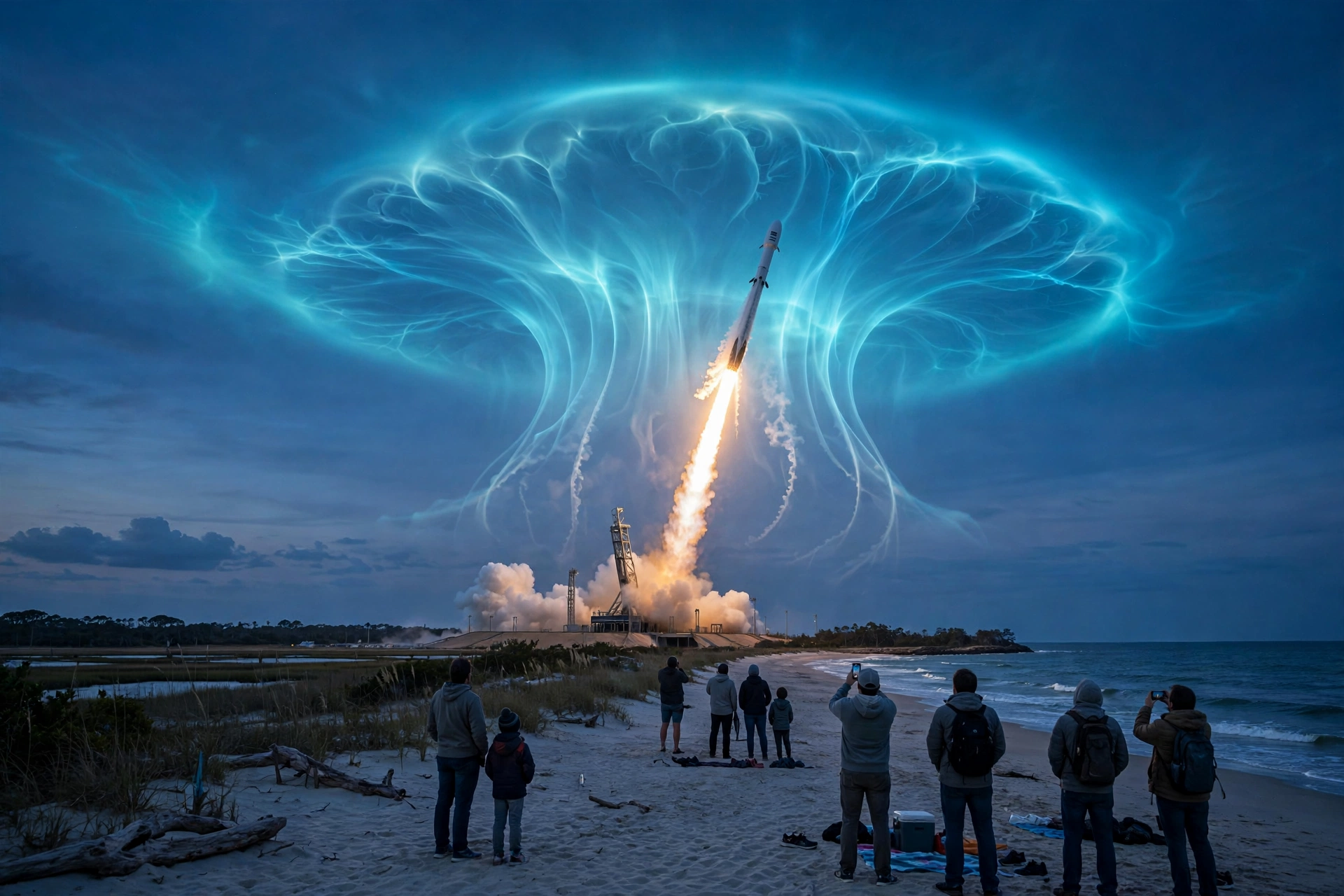
People along the US east coast who looked up at the right moment this week were treated to one of the strangest sights a rocket launch can produce: a vast, glowing, jellyfish-shaped cloud drifting high above the horizon. Photos of the phenomenon spread quickly online, with many viewers wondering whether they were seeing something natural, something man-made, or something stranger still.
The answer is both natural and man-made. A SpaceX rocket created the conditions, and sunlight, altitude and exhaust gases did the rest. The result is known as a space jellyfish, and it is one of the most beautiful side effects of the modern launch era.
What Witnesses Saw
The cloud appeared in twilight, when the ground below was already darkening but the upper atmosphere was still lit by the Sun. Against that dim sky, the rocket’s expanding exhaust plume caught the light and bloomed into a translucent shape with a bright head and trailing tendrils, closely resembling a jellyfish swimming across the sky.
Reports and images were shared widely, including in the science community on Reddit, while The Guardian covered the sightings off the east coast. For many onlookers it lasted only minutes, but that was long enough to stop people in their tracks and send cameras pointing skyward.
The Twilight Phenomenon, Explained
The space jellyfish is a textbook example of what scientists call a twilight phenomenon. It depends on a very specific contrast. After sunset, or before sunrise, an observer on the ground is in darkness, but objects tens or hundreds of kilometres above the Earth can still be in full sunlight. A rocket climbing through that band carries its exhaust from shadow into light.
High in the thin upper atmosphere, exhaust gases are not contained the way they are near the ground. With little air pressure to hold the plume together, it expands rapidly into a huge, diffuse cloud. Sunlight scattering through that cloud makes it glow, often in whites, blues and soft oranges, while the rocket’s motion stretches part of the plume into wispy trails. Those trails are the jellyfish’s tentacles.
The effect is stronger when a stage separates or a second-stage engine fires at altitude, because fresh exhaust is released directly into the sunlit, low-pressure environment. Winds high above the Earth can then twist and spread the cloud, making the shape more organic and less like a normal aircraft contrail.
Why It Does Not Happen at Every Launch
Timing is everything. A launch in the middle of the day produces a bright plume, but the sky is too bright for the delicate glow to stand out. A launch in full darkness can leave the exhaust in shadow as well. The jellyfish appears in the narrow window around dawn or dusk, when the geometry of Sun, Earth and rocket lines up precisely.
Weather matters too. Cloud cover at lower levels can hide the view entirely, and haze can soften the effect. The rocket’s trajectory also plays a part. Launches that climb quickly to high altitude and travel downrange over the ocean, as many east coast flights do, give large numbers of people a clear line of sight to the expanding plume.
It is a reminder that even highly engineered events still depend on old-fashioned conditions. As our coverage of the future of technology over the next 10 years notes, advances often become most visible when they meet the natural world on its own terms.
Is the Cloud Harmful?
For people watching from the ground, the jellyfish cloud is a visual event, not a hazard. The exhaust is dispersed at very high altitude and spreads over a large area as it fades. The glow disappears as the plume thins out and as the upper atmosphere itself moves out of direct sunlight, usually within minutes.
That does not mean launches have no environmental footprint. Rockets do emit gases and particles in sensitive layers of the atmosphere, and researchers continue to study the cumulative effect as launch rates rise worldwide. The jellyfish itself, though, is simply sunlight revealing material that would otherwise be invisible against a dark sky.
How to See the Next One
The best chance of catching a space jellyfish is to watch for launches scheduled shortly before sunrise or within about an hour after sunset. Choose a spot with an unobstructed view toward the launch site’s downrange path, ideally away from bright city lights, and arrive early. The most striking phase can begin a few minutes after liftoff, once the rocket reaches high altitude, so keep watching even after the initial climb fades.
Binoculars can help reveal structure in the cloud, but no special equipment is needed. A phone camera on a steady surface will often capture the glow well, because the plume is large and bright relative to the twilight sky. Checking the planned trajectory in advance helps you face the right way, since the jellyfish may appear well away from the launch pad itself.
As launch cadence increases, these sightings are becoming a shared public experience rather than a curiosity for space enthusiasts alone. For a few minutes, a routine piece of spaceflight turns the sky into a display that no one had to design. That is why a glowing cloud over the east coast drew such attention: it was technology, weather and sunlight briefly performing together.
